The Node.js Event Loop Explained
Introduction
We know that Node.js is single-threaded, but that doesn’t mean it handles only one task overall. It is single-threaded only for JavaScript execution.
For simple tasks like console.log() or top-level code, this works fine. However, for time-consuming tasks such as I/O operations or file handling, Node.js does not execute them directly on the main thread. Instead, it delegates them to the background (libuv/OS).
In JavaScript, there are two types of operations:
Blocking operations: These block the main thread (e.g., synchronous APIs, CPU-heavy tasks)
Non-blocking operations: These run in the background, keeping the main thread free
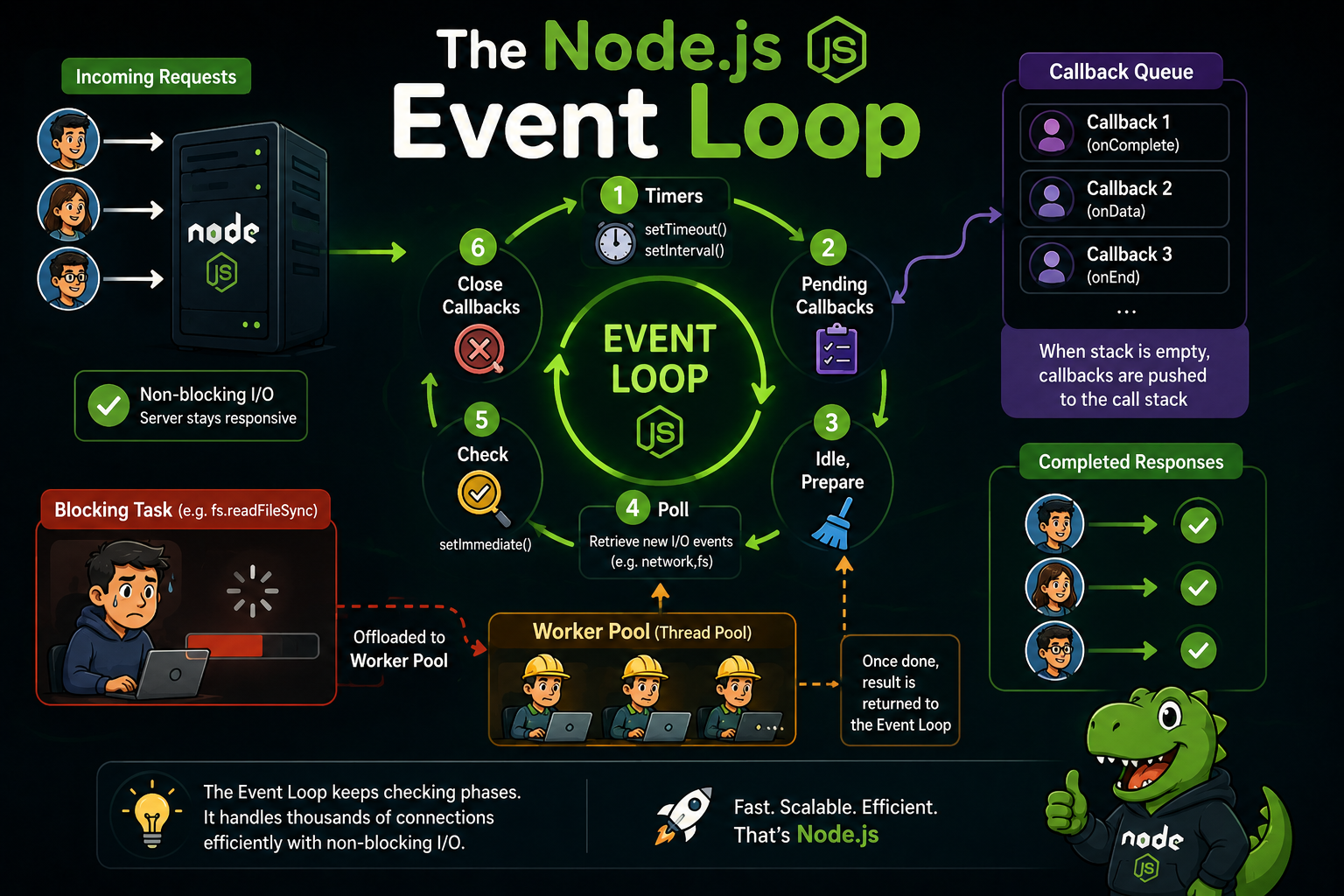
To manage this efficiently, Node.js uses the event loop, which does not execute blocking tasks itself but handles callbacks of completed async operations and ensures the main thread continues running without being blocked.
An in this article we are going deeply understand what this event loop is, So let's start.
What the Event Loop is?
At its core, the JavaScript event loop is responsible for managing the execution of code, collecting and processing events, and executing queued tasks.
JavaScript operates in a single-threaded environment, meaning only one piece of code runs at a time. The event loop ensures that tasks are executed in the correct order, enabling asynchronous programming.
To explain it in simple terms, imagine you’re running a to-do list. The event loop is like a manager that ensures tasks are completed in the right order, depending on their type and urgency.
Why Node.js Needs an Event Loop?
Node.js is a server-side runtime where performance is critical. If it handled only one task at a time on the main thread, the application would perform very slowly.
To avoid this, Node.js uses the event loop, which solves this problem efficiently.
The event loop is the core mechanism that allows Node.js to perform non-blocking I/O operations—such as reading files, querying databases, or handling network requests—without freezing the entire application while waiting for these tasks to complete.
Components of the Event Loop
Call Stack: Keeps track of function calls. When a function is invoked, it is pushed onto the stack. When the function finishes execution, it is popped off.
Web APIs: Provides browser features like
setTimeout, DOM events, and HTTP requests. These APIs handle asynchronous operations.Task Queue (Callback Queue): Stores tasks waiting to be executed after the call stack is empty. These tasks are queued by
setTimeout,setInterval, or other APIs.Microtask Queue: A higher-priority queue for promises and
MutationObservercallbacks. Microtasks are executed before tasks in the task queue.Event Loop: Continuously checks if the call stack is empty and pushes tasks from the microtask queue or task queue to the call stack for execution.
Task Queue vs Call Stack
| Factor | Call Stack | Task Queue |
|---|---|---|
| Execution Model | Executes functions (LIFO) | Stores async callbacks (FIFO) |
| Nature | Synchronous | Asynchronous |
| Processing | One function at a time | Multiple callbacks can wait |
| Blocking Behavior | Blocks on heavy tasks | Does not block execution |
| Ownership | Part of JS engine | Managed by Node.js / browser APIs |
| Trigger | Runs immediately | Runs when stack is empty |
| Examples | console.log() |
setTimeout(), I/O callbacks |
| Scheduling | No scheduling | Works with event loop |
How Async Operations are Handled?
When operations start executing, they first enter the Call Stack, where variable declarations and function calls are executed.
If a task takes time (such as I/O operations), it is not moved out of the Call Stack. Instead, Node.js delegates it to the background (libuv/OS) and registers its callback.
Once the async task is completed, its callback is added to the Callback Queue (Task Queue).
The Event Loop continuously checks:
If the Call Stack is empty → it takes the next callback from the queue and pushes it to the Call Stack
Then the callback gets executed.
Timers vs I/O Callbacks
| Factor | Timers | I/O Callbacks |
|---|---|---|
| Definition | Execute after a specified delay | Execute after I/O operation completes |
| Trigger | Time-based (setTimeout, setInterval) |
Completion of async I/O (file, network) |
| Phase (Event Loop) | Timers phase | I/O callbacks phase |
| Execution Guarantee | Minimum delay, not exact timing | Runs as soon as I/O finishes |
| Dependency | Depends on timer duration | Depends on I/O completion time |
| Priority | Checked earlier in loop | Runs after poll phase |
| Use Cases | Delays, scheduling tasks | File read/write, DB queries, API calls |
| Example | setTimeout(fn, 1000) |
fs.readFile(path, cb) |
Role of Event Loop in Scalability
The event loop is central to scalability, particularly in Node.js, by enabling high concurrency on a single thread through non-blocking, asynchronous I/O operations.
It allows a server to handle thousands of simultaneous connections without the resource overhead of creating new threads for every request, making it ideal for I/O-intensive applications.
Role of event loop
Non-Blocking I/O Handling: The event loop offloads operations like file system access, database queries, or network requests to the system kernel or a background thread pool. This allows the main thread to immediately return to accepting new requests rather than waiting for I/O to finish.
Single-Threaded Efficiency: By using a single-threaded approach, it avoids the heavy memory consumption and performance costs associated with thread creation and context switching.
High Concurrent Connections: Instead of tying up a thread per user (which limits capacity), the loop acts as a task scheduler, processing callbacks only when I/O operations complete. This keeps the server responsive.
Conclusion
The event loop plays a critical role in the architecture of Node.js. Without it, Node.js cannot function effectively on a server, because servers require handling multiple tasks concurrently with high performance.
The event loop enables Node.js to process many requests without creating a new thread for each task. Without it, Node.js would need a multi-threaded model like Java or PHP, where each task typically uses a separate thread.
Overall, the event loop is the core component that makes Node.js fast and efficient for large-scale applications.
Hope you liked this article❤️


